Published: March 2026 | Reading Time: 13 minutes | Author: TeleSecure360 Clinical Operations Team
Knowing how to reduce no shows in clinics is one of the most valuable operational skills a clinic manager can develop in 2026. Empty appointment slots mean lost revenue, disrupted care continuity, and providers standing ready in rooms that should be full. The clinics that have cracked this problem share a single insight: no shows are not a scheduling issue — they are a patient engagement issue. This guide breaks down exactly how to reduce no shows in clinics with six proven strategies, real numbers, and the tools that make each one work in practice.
TL;DR — Quick Wins Checklist:
- ✅ Send automated appointment reminders across SMS, email, and app — at 72 hours, 24 hours, and 2 hours before
- ✅ Enable online rescheduling so patients don’t simply disappear
- ✅ Offer telehealth as a fallback when in-person visits feel burdensome
- ✅ Track no-show patterns by time slot, provider, and patient demographics
- ✅ Maintain an active cancellation waitlist to fill vacated slots immediately
- ✅ Use a platform like TeleSecure360 to stay connected between visits
- ✅ Build a cancellation policy that is firm but patient-friendly
- ✅ Use chronic care management tools to keep high-risk patients engaged
Every clinic manager knows the frustration: a fully booked schedule, staff prepared, providers available — and then silence. And engagement is a problem that technology, data, and smarter communication can solve systematically.
Why Learning How to Reduce No Shows in Clinics Is Now a Strategic Priority
Across the global healthcare industry, patient no-shows sit at an average rate of 18–23% depending on specialty and geography. Primary care, mental health, and chronic disease management see the highest rates. Dermatology and elective specialist visits rank close behind.
What makes this a crisis — rather than simply an operational headache — is the compounding effect:
- A missed appointment is not a neutral event. For a patient managing hypertension, diabetes, or a post-surgical recovery, a skipped check-in is a direct clinical risk.
- Clinics that rely entirely on in-person revenue and have no digital fallback lose that appointment entirely — with no recovery mechanism.
- Administrative staff spend an estimated 14 minutes per no-show on follow-up calls, rescheduling attempts, and record updates. That adds up quickly in a practice seeing hundreds of patients per week.
The providers and clinic managers searching for solutions to no shows in clinics are right to treat this as a strategic priority — not a background inconvenience. The good news is that the solutions are well-established, and the data on what actually works is clear.
The Real Cost of No Shows in Clinics — By the Numbers
Before investing in solutions, it helps to understand the full financial picture. Hard numbers make the business case for change.
In the United States alone, patient no-shows cost the healthcare system an estimated $150 billion annually (Merritt Hawkins — one of the most widely cited benchmarks in healthcare operations literature). Individual clinics lose between $200–$300 per missed appointment, depending on specialty and region. Globally, the figure is considerably higher when accounting for the volume of appointments across healthcare systems in Asia, Europe, and emerging markets.
For a mid-sized clinic seeing 20 no-shows per week, that translates to:
| Weekly No-Shows | Lost Per Visit | Annual Revenue Loss |
|---|---|---|
| 10 | $250 | ~$130,000 |
| 20 | $250 | ~$260,000 |
| 30 | $250 | ~$390,000 |
Beyond the revenue impact, however, there is a direct clinical cost. Patients who miss appointments — particularly those managing chronic conditions — face measurably higher risks of:
- Disease deterioration requiring emergency intervention
- Hospital readmissions that are preventable with consistent care
- Medication non-adherence due to lack of prescription renewals
- Poor long-term health outcomes across a range of conditions
No shows in clinics are not just a revenue problem. They are, fundamentally, a patient health problem. That reframing matters — because it shapes every solution that follows.
Why Patients Miss Appointments — The Root Causes Clinics Get Wrong
Most no-show reduction strategies jump straight to tactics — sending more reminders, charging fees — without first understanding why patients miss appointments. That is the mistake. The root causes of no shows in clinics are considerably more nuanced than “patients don’t care,” and addressing them directly produces far better results than generic interventions.
They Forgot
An appointment booked three weeks in advance competes with everything else in a patient’s life. Without a proactive reminder sequence, forgetting is the path of least resistance — and the most common driver of first-time no-shows.
Logistics and Transportation Barriers
For elderly patients, those with mobility issues, or patients in rural areas, getting to a clinic is a genuine logistical challenge. When the physical effort of the trip feels harder than the perceived benefit, the default is not to go. This is especially prevalent in patients managing multiple chronic conditions.
Anxiety and Avoidance
For patients managing mental health conditions, chronic diseases, or any diagnosis that carries emotional weight, returning to a clinic to hear a progress update can trigger real anxiety. Avoidance is a documented clinical behaviour — not indifference or disrespect. Treating it as such leads to policies that alienate rather than re-engage.
“I Feel Fine” — The Routine Visit Problem
For check-ins and routine monitoring, patients who feel well on the day of the appointment frequently rationalise skipping: “I’ll reschedule when I have time.” That reschedule often never happens. Moreover, the “I feel fine” patient is often the chronic disease patient who most needs the visit — precisely because they are not yet symptomatic.
Friction in Cancellation and Rescheduling
This is the root cause clinics most consistently overlook. If the only way to cancel an appointment is to call and wait on hold, patients will not call. They will simply not show up. Removing that friction — by making cancellation and rescheduling digital, instant, and two-way — directly converts would-be no-shows into rescheduled appointments that can be tracked and recovered.
Understanding which of these drivers is most prevalent in your patient population is, therefore, the essential first step of any plan for how to reduce no shows in clinics effectively.
Strategy 1: Build a Multi-Channel Reminder System That Meets Patients Where They Are
The evidence on automated reminders is unambiguous: they reduce no shows in clinics by 29–36% depending on the channel, timing, and whether they support two-way response.
The mistake most clinics make is treating a single phone call reminder as a complete reminder strategy. Patients today live digitally. They text more than they talk. They check apps more than they check voicemail. As a result, a reminder that does not reach a patient through their primary communication channel is effectively no reminder at all.
The Optimal Reminder Sequence
| Timing | Channel | Action |
|---|---|---|
| 72 hours before | SMS + Email | Confirm or reschedule link |
| 24 hours before | SMS + Push notification | Final confirmation |
| 2 hours before | SMS | Last-chance check-in |
Why Two-Way Messaging Is the Fastest Way to Reduce No Shows in Clinics
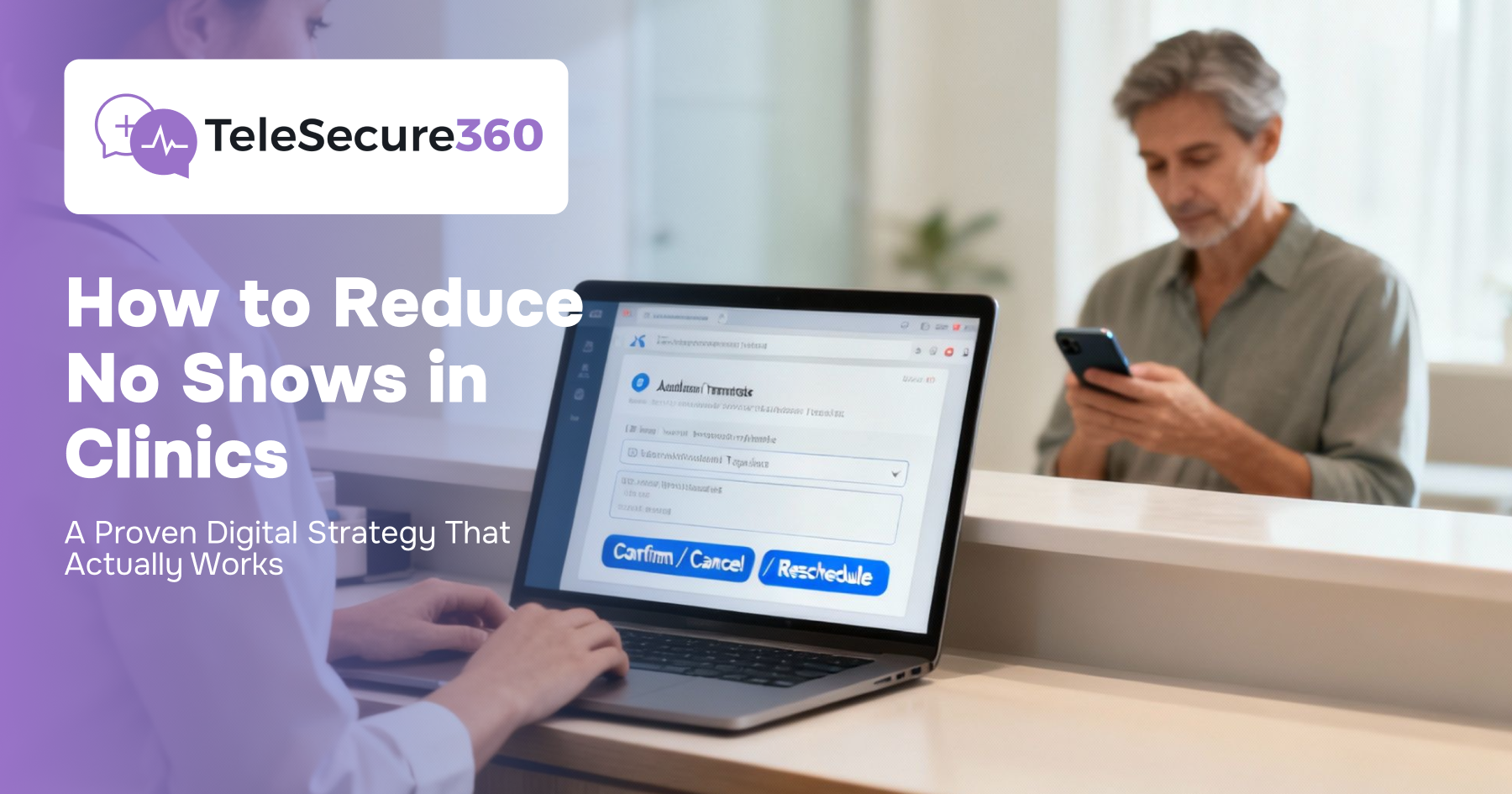
Standard reminders inform patients about an appointment. Two-way reminders let patients respond — “C” to confirm, “R” to reschedule — without requiring a phone call to the clinic.
When rescheduling is as easy as sending a single text, patients who cannot make it will tell you in advance. That gives your clinic the chance to fill the slot with another patient through a cancellation waitlist, rather than losing the appointment entirely. We cover waitlist management in detail in Strategy 6.
A patient-facing telemedicine app with built-in push notifications and two-way messaging takes this further still — enabling clinics to keep patients engaged across the entire appointment lifecycle, not just in the 48 hours before a visit.
Strategy 2: Offer Telehealth as a No-Show Safety Net for Clinics
This is the most underleveraged strategy in no-show reduction — and the one with the most immediate, measurable impact on appointment completion rates.
When a patient realises on the morning of their appointment that they cannot make it — because of work, childcare, transportation, or how they are feeling — what are their options? In a traditional clinic: cancel or no-show. In a telehealth-enabled clinic: switch to a virtual visit in under two minutes.
Offering telehealth as a same-day fallback eliminates an entire category of no shows in clinics that have nothing to do with patient disengagement, and everything to do with logistics. Furthermore, research consistently shows that clinics offering telehealth alternatives see not only lower no-show rates but also higher patient satisfaction scores — because patients feel their time and constraints are respected.
For a full breakdown of what telehealth software costs versus the ROI it delivers, see our guide on telemedicine software vs in-person consultations: cost and ROI comparison.
Appointment Types Best Suited for a Telehealth Fallback
Chronic disease management — patients managing diabetes, hypertension, heart disease, or long-term mental health conditions benefit enormously from flexible check-ins. A virtual visit completable in 15 minutes from a patient’s workplace is one they will keep. Notably, the “I feel fine” patient who would skip a routine in-person visit will frequently complete the equivalent virtual check-in.
Post-procedure follow-ups — when a follow-up is primarily conversational (reviewing test results, discussing symptoms, adjusting medication), physical presence is often not clinically necessary. Offering a telehealth option preserves the full clinical value of the visit without requiring the patient to travel.
Mental health appointments — for some patients, in-person anxiety is itself a driver of avoidance. A virtual consultation removes that barrier entirely, and additionally gives the patient a familiar, lower-stakes environment for sensitive conversations.
Routine check-ins — the “I feel fine, I’ll reschedule” patient is exactly the patient who will complete a 10-minute virtual visit from their home. Converting routine in-person check-ins to telehealth-first for appropriate patients is one of the fastest ways to move a no-show metric.
Before committing to a telehealth solution, it is worth reviewing what telemedicine platform features your clinic should look for in 2026 to ensure the platform you choose supports same-day switching, two-way video, and compliant messaging without friction.
TeleSecure360 was built around this philosophy: giving healthcare professionals a virtual practice that allows them to be securely reachable to their patients through web and mobile applications. Providers can monitor patients remotely, conduct video consultations, and review health data between visits — so care continues even when patients cannot be physically present. In practice, this is one of the most direct answers to how to reduce no shows in clinics that any platform can offer.
Strategy 3: Use Data to Predict and Prevent No Shows in Clinics Before They Happen
What gets measured gets managed. Clinics serious about reducing no shows move beyond reactive tracking — counting missed appointments after the fact — and into predictive analysis: identifying which patients and appointment types are at highest risk, then intervening before the appointment date arrives.
The Metrics Every Clinic Should Track
- No-show rate by provider — some providers have measurably more engaged patient panels than others. Understanding why reveals replicable engagement patterns that can be standardised across the practice.
- No-show rate by appointment type — new patients no-show at significantly higher rates than returning patients. Consequently, first-visit onboarding flows that build familiarity and investment before the appointment can close that gap.
- No-show rate by time slot — Monday mornings and Friday afternoons are historically higher-risk across most specialties. This data can inform both scheduling strategy and targeted reminder intensity.
- No-show rate by patient demographics and condition status — chronic disease patients, elderly patients, and patients with social determinants of health challenges need proactive outreach, not standard reminders.
How to Reduce No Shows in Clinics Using Targeted Data Intervention
Once highest-risk segments are identified, targeted interventions become possible rather than guesswork.
If new patients no-show at twice the rate of returning patients → build a pre-appointment digital onboarding flow that creates investment and familiarity before the first visit. A welcome message, a short video from the provider, and clear instructions on what to bring all reduce the psychological distance between booking and arrival.
If Friday afternoon slots have 30% higher no-show rates → consider strategic overbooking of those slots by 10–15%, or converting them to telehealth-first by default. Overbooking, when applied selectively to high-risk time slots rather than across the board, functions as a practical buffer — not a patient inconvenience.
If chronic disease patients are consistently missing quarterly check-ins → implement automated proactive outreach through a platform that puts patient health information at the centre of care management, flags missed refills, and triggers personalised check-in messages.
Platforms that surface this data automatically, flag high-risk patients, and trigger outreach workflows are no longer a luxury for large hospital systems. They are accessible, practical infrastructure for any clinic serious about how to reduce no shows in clinics at scale.
Strategy 4: Design a Cancellation Policy That Educates Without Alienating
A cancellation policy is not just an enforcement mechanism. It is, above all, a communication tool — and the tone of that communication largely determines how patients respond to it.
Clinics that frame no-show policies around care rather than punishment consistently see better patient compliance. The language, therefore, matters enormously.
What Works
Inform patients at booking — verbally, not just in writing. A clear, human statement at the point of scheduling: “We hold this appointment specifically for you. Letting us know 24 hours in advance if you need to reschedule means we can offer that time to another patient who needs care.”
Frame it around shared responsibility. Patients who understand the real impact of a missed appointment on other patients are more likely to cancel in advance. Most people do not want to harm others; they simply do not connect their individual no-show to a system-level consequence. Making that connection explicit — gently — changes behaviour.
Reserve fees for repeat behaviour, not first incidents. Charging a first-time no-show drives patient churn. A modest fee for a second or third no-show, communicated clearly at the point of booking, is both fair and effective as a deterrent.
Follow up with empathy after a no-show, not a bill. A patient who no-shows is often already disengaged from their care. A re-engagement message — not a fee notice — is the intervention most likely to bring them back. See the re-engagement protocol below.
The Post No-Show Re-Engagement Protocol
This is the step most clinics skip entirely — and it is one of the highest-leverage moments in the patient relationship.
Within 24 hours of a missed appointment, send a message through the patient’s preferred channel that:
- Acknowledges the missed visit without blame — “We noticed you weren’t able to make your appointment yesterday.”
- Offers an immediate easy path back — a one-tap rescheduling link, or a telehealth option for the same week
- For chronic disease patients specifically: flags the clinical importance of the visit without inducing anxiety — “Keeping up with your [condition] check-ins helps us catch anything early — we want to make it as easy as possible to reschedule.”
Clinics that implement a structured re-engagement protocol recover an estimated 15–25% of no-shows as rescheduled appointments within two weeks. That is revenue and care continuity that would otherwise be permanently lost.
What Does Not Work
- Aggressive fee policies enforced inconsistently across providers or patient types
- Cancellation windows that are too short to be realistic for working patients or those with caregiving responsibilities
- Policies communicated only in writing at booking, never reinforced verbally or in reminders
The goal is for patients to feel like partners in their own care — not subjects of an administrative billing policy.
Strategy 5: Close the Engagement Gap Between Visits
Here is the insight that most no-show reduction strategies miss entirely: no shows in clinics do not begin on the morning of the appointment. They begin the moment a patient loses connection with your practice.
When a patient feels genuinely engaged, supported, and remembered between visits, they show up. When a patient books an appointment three weeks out, hears nothing from the clinic until a generic reminder the day before, and has had no meaningful interaction in the interim, the appointment feels abstract — and abstract appointments are easy to skip.
What Closing the Engagement Gap Looks Like in Practice
- Secure messaging between appointments — patients can ask questions without waiting for their next visit. That access creates a sense of ongoing relationship, not just transactional encounters.
- Prescription and care plan reminders delivered through the patient’s preferred digital channel — keeping the care plan present in the patient’s mind between visits.
- Access to personal health records and progress metrics — patients who can see their own data feel invested in the outcome. Investment drives attendance.
- Proactive outreach when data signals a risk — missed medication refill, declining engagement score, upcoming high-risk period. These triggers should generate an automated, personalised outreach — not wait for the patient to call.
This kind of ongoing digital presence transforms a passive patient into an engaged one — and an engaged patient into one who consistently shows up. As virtual care becomes a permanent fixture of the healthcare system, understanding the future of virtual care and smart EMR for modern clinics is increasingly relevant to how clinics plan their engagement infrastructure.
TeleSecure360 enables healthcare professionals to stay in touch with their patients online, encourages patients to participate in their own healthcare journey, and puts patient health information at the centre of chronic care management. This matters especially for patients managing chronic diseases, where consistent, responsive care between appointments is a clinical necessity — not a convenience. It is also why ongoing digital engagement is the single most overlooked element in how to reduce no shows in clinics sustainably.
Strategy 6: Optimise the Scheduling Experience and Build a Cancellation Waitlist
Sometimes the no-show problem begins before a patient ever books. If the scheduling experience is frustrating — long hold times, inflexible slots, no online option — patients begin the relationship disengaged. That disengagement compounds over time and, ultimately, manifests as a missed appointment.
Scheduling Improvements With Immediate Impact
Offer online self-scheduling. Patients who book their own appointments feel greater ownership over them. Ownership drives accountability. Clinics offering online booking consistently see measurably lower no-show rates for self-scheduled versus staff-scheduled appointments — because the act of choosing a slot creates psychological commitment.
Reduce appointment lead times where possible. The relationship between lead time and no-show rate is well-documented: the longer the wait between booking and appointment, the higher the likelihood of a no-show. A two-day wait produces far fewer no-shows than a three-week wait. Where reducing lead times is not operationally feasible, compensate with a more intensive engagement sequence in the intervening period.
Offer early morning, evening, and weekend availability. Working adults and parents of young children cannot reliably take time off for mid-morning appointments. Flexible scheduling converts patients who would otherwise skip into patients who can actually attend — without changing clinical outcomes.
Confirm via the patient’s preferred channel, not the clinic’s preferred channel. A patient who prefers SMS and receives only a phone call confirmation may not receive the confirmation at all. Channel preference should be captured at registration and respected at every subsequent touchpoint.
Build and Maintain an Active Cancellation Waitlist
This is one of the most operationally impactful tools available to clinics — and one of the least consistently used.
A cancellation waitlist is a real-time list of patients who want an earlier appointment than the one they were given, or who can attend on short notice when a slot opens. When a patient cancels or no-shows, that slot is immediately offered to the next patient on the waitlist rather than sitting empty.
How to make a waitlist work in practice:
- Capture waitlist preference at booking — “Would you like us to contact you if an earlier slot becomes available?”
- Use automated SMS or app notifications to offer vacated slots — the faster the notification, the higher the fill rate
- Set a response window of 30–60 minutes: if the first waitlisted patient does not respond, the slot automatically moves to the next
- For high-demand providers or specialties, a waitlist can fill 60–80% of cancelled and no-show slots within the same day
When combined with a telehealth option for patients who cannot travel on short notice, a waitlist system transforms a no-show from a pure revenue loss into a recoverable event in the majority of cases. For a full view of how telemedicine platform pricing works at different scales, see our complete guide to telemedicine platform pricing in 2026.
How TeleSecure360 Helps Clinics Eliminate No Shows — In One Platform
The six strategies above work independently. They work considerably better together — and the platform connecting them matters enormously to the outcome.
TeleSecure360 was developed by a dedicated team committed to transforming the way healthcare is provided and accessed. It brings together every tool needed to address the root drivers of how to reduce no shows in clinics within a single, secure, fully brandable platform. For healthcare providers evaluating whether a white label telemedicine software solution is right for their organisation, TeleSecure360 offers an end-to-end platform that requires no custom development to deploy.
| No-Show Driver | TeleSecure360 Solution |
|---|---|
| Patients forget appointments | Automated multi-channel reminders with two-way response |
| Logistics make in-person attendance difficult | Built-in telehealth for same-day virtual fallback |
| Patients feel disengaged between visits | Secure messaging, health record access, ongoing digital presence |
| High-risk patients go unmonitored | Remote patient monitoring and proactive outreach tools |
| Scheduling is inflexible or friction-heavy | Patient-facing self-scheduling through web and mobile |
| Cancellation requires a phone call | Two-way SMS and app-based rescheduling |
| Vacated slots go unfilled | Waitlist notification automation with response-window logic |
The result is a clinic that is reachable, responsive, and present in a patient’s life — not just on the day of an appointment. That ongoing connection is the most durable predictor of whether a patient consistently shows up.
Frequently Asked Questions: How to Reduce No Shows in Clinics
What is an acceptable no-show rate for a clinic?
Industry benchmarks vary by specialty, but most healthcare operations experts consider a no-show rate below 10% to be well-managed. Primary care averages tend to run between 15–23%. Any rate above 20% should be treated as a signal for immediate strategic review and intervention.
Do no-show fees actually reduce no-show rates?
The evidence is mixed. No-show fees reduce repeat no-shows among patients who are already engaged but occasionally forgetful. They are, however, less effective — and can be actively counterproductive — for patients who are disengaged, anxious, or facing socioeconomic barriers. As a result, fees work best as one component of a broader engagement strategy, not as a standalone solution.
Is telehealth effective at reducing in-clinic no-shows?
Yes — significantly. Studies consistently show that clinics offering same-day telehealth alternatives see measurable reductions in in-person no-show rates, as patients who cannot attend physically are given a viable, low-friction alternative rather than a binary choice between attending and not attending.
How much do automated reminders reduce no-shows?
Automated multi-channel reminders reduce no-show rates by 29–36% on average, with the highest reduction rates observed when reminders support two-way response — allowing patients to confirm, reschedule, or cancel via SMS or app without making a phone call.
What patient types have the highest no-show risk?
New patients, patients with long appointment lead times, patients managing mental health conditions, elderly patients with transportation barriers, and patients in lower socioeconomic groups consistently show higher no-show rates across the research literature. Each of these groups requires a tailored intervention approach, not a generic reminder sequence.
How does a cancellation waitlist reduce no-show revenue loss?
A well-managed cancellation waitlist fills 60–80% of vacated slots on the day they open, depending on how quickly notifications are sent and how many patients are waitlisted. Combined with a telehealth fallback for short-notice patients, a waitlist system converts the majority of no-show revenue losses into completed appointments.
The Bottom Line: How to Reduce No Shows in Clinics — It’s a Digital Engagement Problem
Clinics that successfully learn how to reduce no shows in clinics do not do it through punitive policies or generic reminders alone. They do it by building a connected, digital-first patient experience that keeps patients engaged from the moment of booking through the moment they arrive — or log into their virtual visit.
No shows in clinics will never reach zero. However, with the right combination of proactive multi-channel reminders, telehealth fallbacks, data-driven risk identification, post no-show re-engagement, cancellation waitlists, and ongoing digital engagement, a clinic operating at 22% no-show rates can realistically reach 10% or below — and the clinical and financial impact of that shift is transformative.
TeleSecure360 is the platform built to make that shift possible — purpose-built for healthcare providers who understand that patient engagement is not a marketing function. It is a clinical one.
If reducing no shows in clinics is a priority this year — and it should be — the path forward is clear: go digital, go patient-first, and stay connected.
→ Schedule a Free TeleSecure360 Demo | Explore Platform Features | Talk to Our Team
TeleSecure360 is a white label telemedicine platform supporting healthcare providers globally with compliant, branded virtual care. For questions about this article or our clinical operations team, contact us directly.