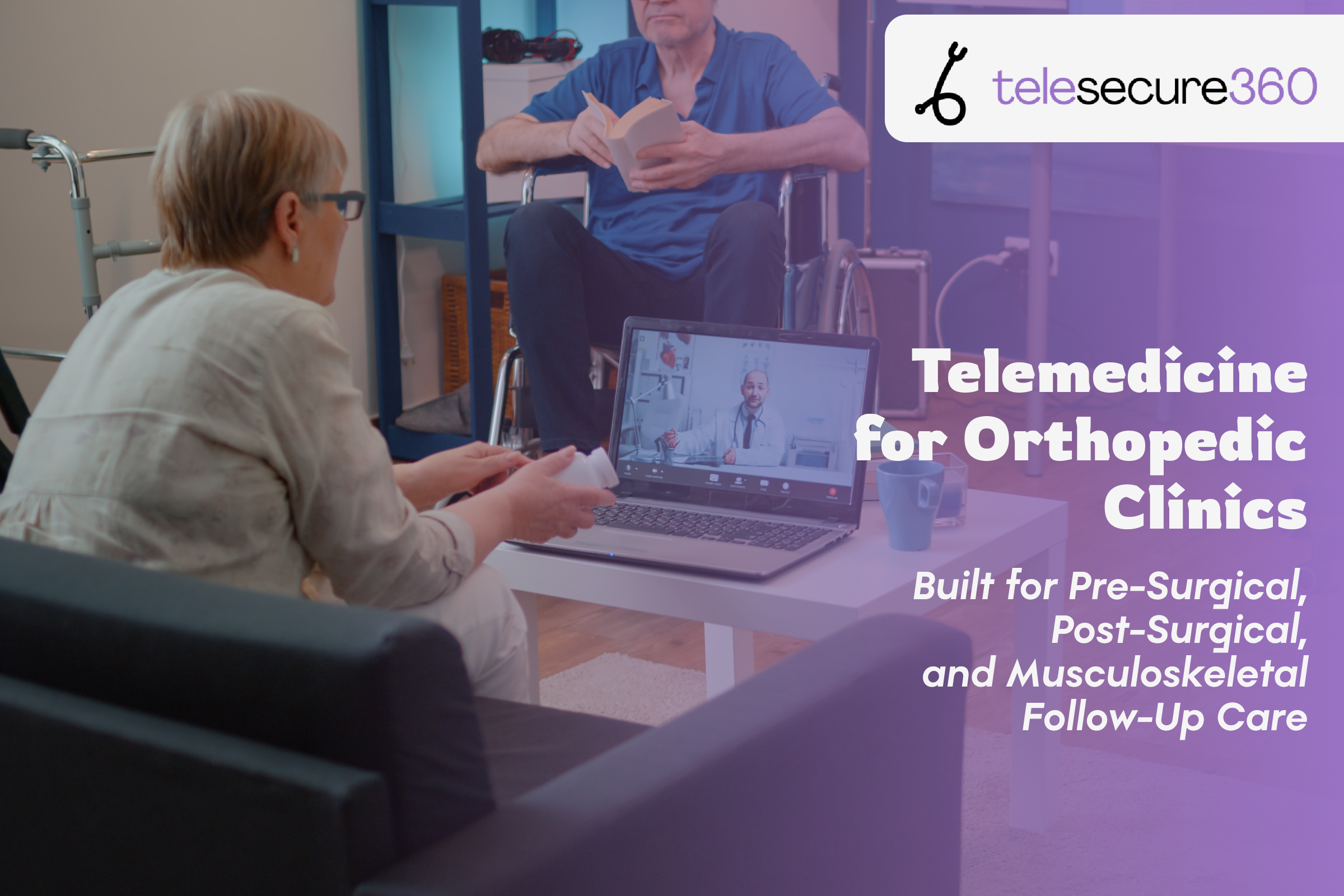
The majority of orthopedic appointments after a diagnosis is established do not require the patient to be physically present. Post-surgical check-ins, imaging reviews, physiotherapy progress assessments, and medication management are all clinically appropriate for remote delivery — if the platform is built for orthopedic workflows, not adapted from a generic telemedicine tool. TeleSecure360 is built for exactly that.
Why Orthopedic Clinics Are Adopting Dedicated Telehealth Platforms
Orthopedic patients face a specific access problem that telemedicine resolves more effectively than almost any other clinical intervention. A patient who has just had a knee replacement, a rotator cuff repair, or a spinal decompression procedure is, by definition, in pain, limited in mobility, and frequently dependent on others for transport. Asking that patient to travel to a clinic for a ten-minute post-operative check-in — when the clinician is reviewing wound healing, checking range of motion progress, and adjusting pain management — is a burden that serves neither the patient nor the clinic.
The clinical case for telemedicine for orthopedic clinics is not speculative. Research consistently shows that post-surgical follow-up via video consultation produces equivalent outcomes to in-person review for a significant proportion of orthopedic patients, with higher patient satisfaction scores and measurably lower non-attendance rates. Patients recovering from surgery attend remote follow-ups at higher rates than in-person appointments — because attendance does not require them to be mobile.
Beyond post-surgical care, orthopedic telemedicine has established clinical applications across initial triage of musculoskeletal complaints, remote musculoskeletal consultation for chronic conditions like osteoarthritis and lower back pain, physiotherapy referral and progress review, imaging result discussions, and pre-surgical consultations where physical examination has already been completed.
What orthopedic clinics need from a virtual orthopedic consultation software is precision — structured workflows for different consultation types, imaging review capability, physiotherapy referral documentation, and a compliance infrastructure that covers the whole operation. TeleSecure360 delivers that, in a platform that carries your clinic’s brand throughout.
What Orthopedic Clinics Need That Generic Platforms Don’t Provide
Post-surgical follow-up workflows.
Post-operative review is the highest-volume remote consultation type in orthopedic practice. TeleSecure360 supports structured post-surgical appointment types with pre-configured intake forms — wound healing status, pain scores, mobility progress, medication compliance — completed by the patient before the session begins. The surgeon arrives at the consultation with current patient-reported data, not a blank slate.
Imaging review and documentation.
Orthopedic consultations are frequently driven by imaging — X-rays, MRI scans, CT results. A remote consultation platform for teleconsultation for orthopedic surgeons needs to support secure image sharing and review within the session environment. TeleSecure360 supports pre-session document and image submission, allowing patients to upload imaging reports and scans ahead of their appointment for review during the consultation.
Physiotherapy referral and progress tracking.
Orthopedic recovery is rarely managed by the surgeon alone. Physiotherapists, rehabilitation specialists, and pain management consultants are involved in most post-surgical care pathways. TeleSecure360 supports structured referral documentation — with the patient’s surgical history, current functional status, and rehabilitation goals included — and allows physiotherapy progress notes to feed back into the patient’s central record accessible to the treating orthopedic surgeon.
Pre-surgical consultation workflows.
Once a patient has been assessed in person and a surgical decision has been made, many pre-operative consultations — anaesthetic review discussions, surgical consent clarification, pre-operative instruction delivery — can be conducted remotely. TeleSecure360 supports dedicated pre-surgical appointment types with specific documentation templates and digital consent form delivery.
Chronic musculoskeletal condition management.
Patients with osteoarthritis, chronic lower back pain, or inflammatory joint conditions require regular review without always requiring in-person examination. TeleSecure360 supports recurring appointment scheduling with structured templates for chronic condition monitoring — pain scores, functional assessments, medication review, and treatment plan updates — reducing the in-person burden for both patient and clinic.
Multi-provider orthopedic team coordination.
Orthopedic clinics typically operate with surgeons, registrars, physiotherapists, and clinical coordinators working across the same patient caseload. TeleSecure360’s unified scheduling dashboard gives the whole team visibility — with role-based access ensuring each member sees what their clinical role requires, and nothing beyond it.
HIPAA Compliance for Orthopedic Telemedicine
Orthopedic patient records span a complex clinical journey — initial assessment, imaging investigations, surgical consent documentation, operative notes, post-surgical follow-up records, physiotherapy referrals, and ongoing chronic disease management. The compliance infrastructure protecting that record needs to match its complexity.
Every TeleSecure360 clinic account includes:
Signed Business Associate Agreement (BAA). The legal requirement for HIPAA-compliant telehealth delivery. Provided as standard before your first remote orthopedic consultation goes live. Without a signed BAA, your clinic holds full liability for any data breach occurring during a telemedicine session.
End-to-end encrypted video sessions. All consultations encrypted in transit and at rest. No third-party access to session content, submitted imaging, or clinical documentation. This applies equally to pre-surgical consultations, post-operative reviews, and physiotherapy progress sessions.
Secure document and imaging submission. Patient-submitted documents and imaging files are transferred and stored under the same encryption and access control standards as all other patient data. No unsecured file transfer, no third-party document sharing platform required.
Audit logs per session. A timestamped record of every access event — who viewed which patient’s data, when, and from which device. Essential for orthopedic practices managing long-term patient records spanning multiple surgical episodes.
Role-based access controls. Surgeons, registrars, physiotherapists, and administrative coordinators each access only what their clinical or operational role requires. Cross-role data exposure is prevented at the platform level, not managed manually.
Key Platform Features for Orthopedic Clinics
HD video consultations — browser-based.
Patients join through a link on any device. No downloads, no patient-side accounts. Particularly important for post-surgical patients with limited dexterity or mobility — joining a consultation should never require a patient to navigate a complex technical setup.
Pre-session patient-reported outcome submission.
Configurable intake forms completed by patients before each appointment — pain scores, wound status, functional assessment, medication compliance, mobility progress. The clinician reviews submitted data before the session begins, making consultation time more efficient and clinically focused.
Secure imaging and document upload.
Patients submit imaging reports, scan files, and investigation results ahead of their appointment. Surgeons review imaging within the consultation environment without requiring a separate file transfer process or third-party sharing platform.
Configurable orthopedic appointment types.
Post-surgical review, pre-surgical consultation, chronic musculoskeletal follow-up, physiotherapy progress review, imaging results discussion — each configured with appropriate duration, intake requirements, and documentation templates.
Physiotherapy referral documentation.
Structured referral workflows with surgical history, current functional status, rehabilitation goals, and progress notes attached — feeding back into the central patient record accessible to the treating surgeon.
Automated patient reminders.
WhatsApp, SMS, and email reminders for post-surgical patients who need consistent follow-up engagement. Measurably reduces no-show rates across all appointment types — particularly important in orthopedic practice where missed post-operative reviews can delay identification of complications.
White label branded environment.
Your orthopedic clinic’s name, logo, and colours throughout the patient journey — from booking confirmation to virtual waiting room to post-consultation follow-up message. The experience is entirely yours.
EHR and EMR integration.
Surgical notes, post-operative records, physiotherapy referrals, and imaging results connect to your existing records system. No double entry, no manual reconciliation between the telemedicine platform and your clinical records.
How TeleSecure360 Works for Orthopedic Clinics
Onboarding takes five to seven working days and covers white label branding, surgeon and clinical team account setup, orthopedic appointment type configuration, imaging submission workflow setup, EHR integration, and training for clinical and administrative staff.
After go-live, surgeons and clinicians manage their consultation schedules from individual provider dashboards. Your admin and coordination team manages the full clinic from the unified admin view. Patients receive booking confirmations, pre-session intake prompts, appointment reminders, and post-consultation follow-up messages — all within your branded environment, without downloading anything.
As your clinic grows — additional surgeons, expanded subspecialties, physiotherapy integration, or a second location — the platform scales without reconfiguration.
Frequently Asked Questions
Is telemedicine clinically appropriate for orthopedic post-surgical follow-up?
Yes, for a significant proportion of post-operative review appointments. Wound healing assessment, pain management review, mobility progress evaluation, medication compliance, and patient-reported outcome collection are all clinically appropriate for remote delivery. Physical examination findings requiring hands-on assessment and investigations requiring in-person imaging remain in-person requirements.
Can patients submit imaging and scan results before their appointment?
Yes. TeleSecure360 supports secure pre-session document and imaging submission. Patients upload relevant files ahead of the appointment, and the treating clinician reviews them before the session begins.
Is TeleSecure360 HIPAA-compliant for orthopedic records?
Yes. Every account includes a signed BAA, encrypted sessions and document transfers, audit logs, and role-based access controls as standard. Read the full compliance guide →
Can patients with limited mobility or post-surgical dexterity join sessions easily?
Yes. Patients join through a single browser link on any device. No app download, no account creation, no complex technical navigation required — important for post-surgical patients who may have limited hand function or mobility during recovery.
Does TeleSecure360 support physiotherapy referral workflows?
Yes. Structured referral documentation with surgical history, functional status, and rehabilitation goals is supported within the patient record. Physiotherapy progress notes feed back into the central record accessible to the treating surgeon.
How does TeleSecure360 handle multi-surgeon orthopedic teams?
Each surgeon has their own consultation room, schedule, and patient queue. Your admin and coordination team manages the full surgical team from a unified dashboard with role-based access per staff member and specialty.
The Orthopedic Platform Built for the Full Care Pathway
Post-surgical follow-up. Pre-operative consultations. Chronic musculoskeletal management. Physiotherapy referral and review. Imaging result discussions.
TeleSecure360’s online orthopedic clinic software covers the full orthopedic care pathway — not just the video call in the middle of it. Your patients get a professional, branded remote consultation experience that meets them where they are — often at home, often in recovery, often unable to travel easily. Your clinical team gets a platform that matches orthopedic workflows, not a generic tool that requires workarounds at every step.
The demo is 30 minutes. We walk through your clinic’s consultation types, show you the surgeon and admin experience, and answer your compliance questions directly.
Content reviewed for clinical accuracy by a qualified orthopaedic surgery professional. TeleSecure360 serves orthopedic clinics and musculoskeletal care centres across the United States and India. All plans include HIPAA compliance, a signed BAA, imaging submission workflows, white label branding, and full onboarding support.