

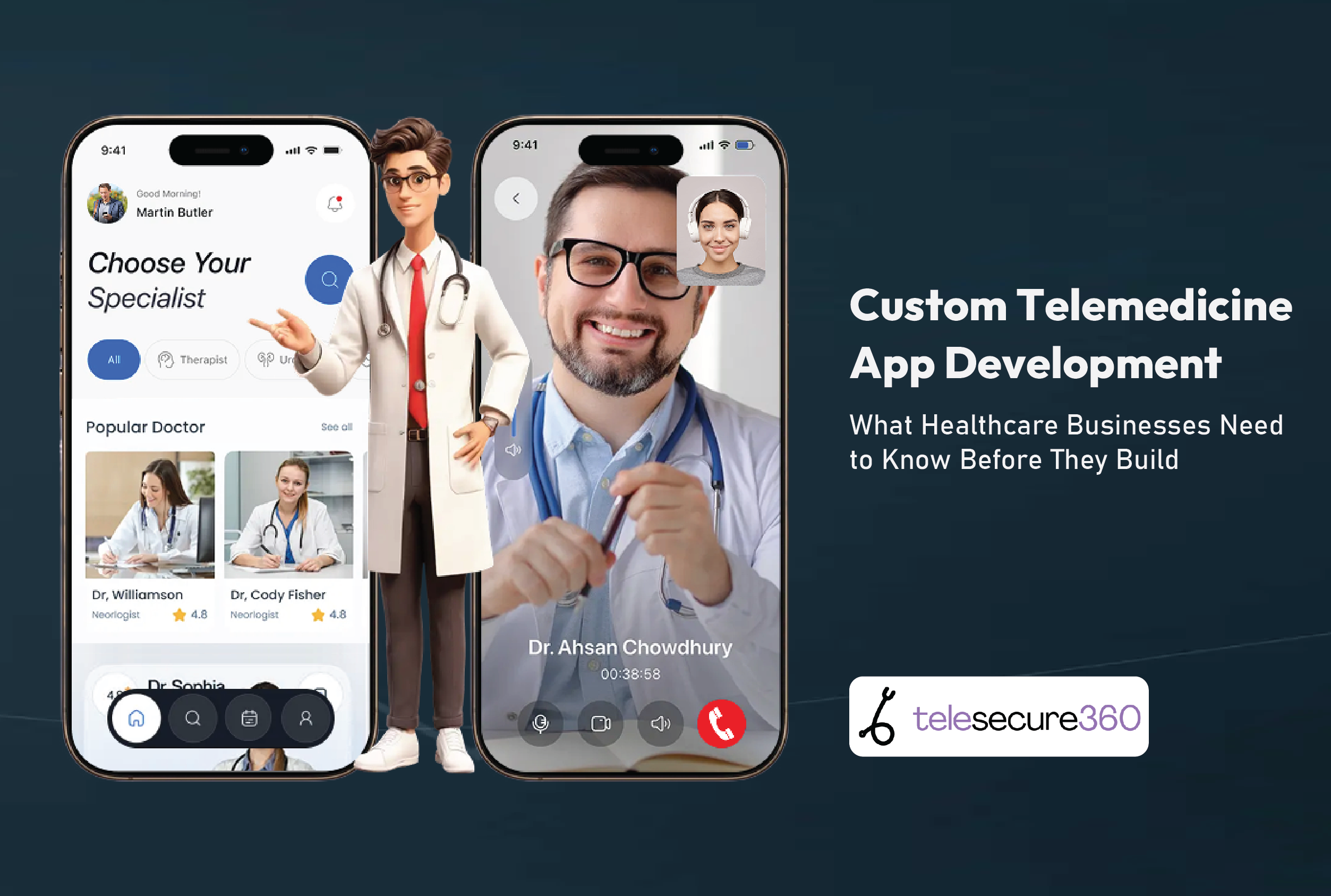
Custom telemedicine app development lets healthcare businesses control features, compliance, and branding. Learn the process, costs, and how to choose the right approach.
Disclaimer: This article is for informational purposes only and does not constitute legal, medical, or compliance advice. Telehealth and data-privacy regulations vary by state and country and change frequently. Consult a healthcare attorney or compliance officer before making decisions about your telemedicine platform’s legal or regulatory posture.
Introduction
A hospital administrator signs a telehealth vendor contract, only to learn six months later that the platform can’t connect to their EHR, doesn’t support the specialty workflows their physicians need, and charges per-user fees that scale faster than revenue. This is one of the most common regrets in digital health today, and it’s why more healthcare organizations are asking a different question: should we build our own telemedicine app instead of renting someone else’s?
The global telemedicine market was valued at roughly $156.31 billion in 2026 and is projected to reach $317.26 billion by 2031, according to Mordor Intelligence’s Telemedicine Market Report (published April 2026). Remote patient monitoring is growing faster than any other segment within that market. That growth is pulling more provider groups, hospital systems, and health-tech startups toward custom telemedicine app development — not because off-the-shelf software is bad, but because generic tools rarely fit specialized clinical workflows, regional compliance rules, or long-term brand strategy.
This guide covers what custom telemedicine app development actually involves: the core features, the realistic cost range, the build process, and how to decide whether custom development or a white-label platform is the smarter starting point for your organization.
What Is Custom Telemedicine App Development?
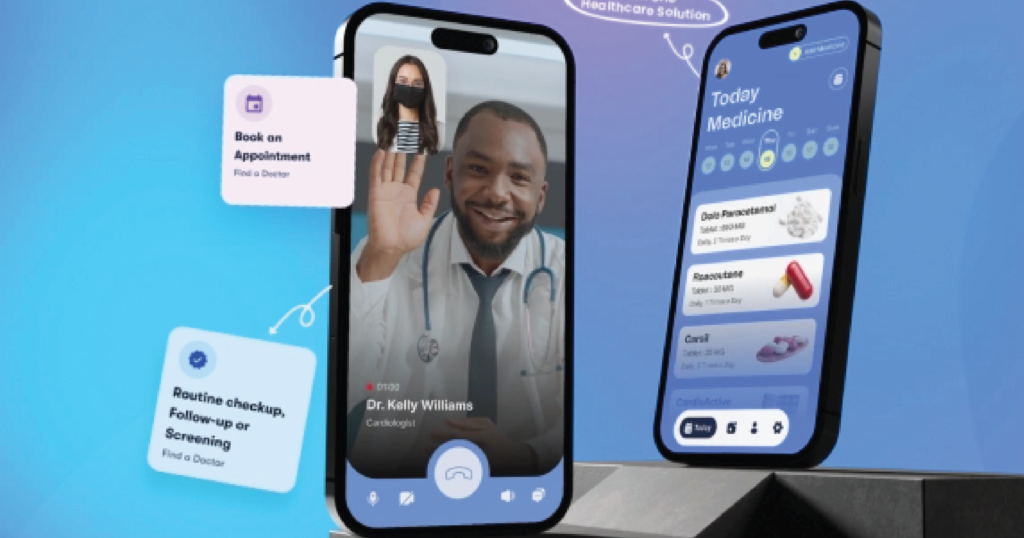
Custom telemedicine app development is the process of designing and building a telehealth platform from the ground up (or on a highly configurable framework) to match a specific organization’s clinical workflows, patient population, and compliance requirements — rather than adopting a pre-built, one-size-fits-all product.
Unlike a standard telehealth app, a custom build gives the healthcare business full control over:
- Clinical workflows — intake forms, triage logic, and specialty-specific documentation
- Integrations — EHR/EMR systems, pharmacy networks, insurance verification, and lab systems
- Branding and patient experience — the app carries the provider’s identity, not a vendor’s
- Data ownership and hosting — where and how patient data is stored and who controls it
- Scalability — the platform grows with patient volume and new service lines instead of hitting vendor plan limits
This approach suits organizations with workflows too specific for generic software, or those planning to offer telehealth as a core, long-term service rather than a stopgap.
Custom vs. White-Label Telemedicine Software

Not every organization needs to build from scratch. Two paths dominate the market: fully custom development, and white-label platforms that provide a pre-built, compliance-ready foundation a business can rebrand and configure.
| Factor | Custom Development | White-Label Platform |
|---|---|---|
| Time to launch | 4–9 months | 2–6 weeks |
| Upfront cost | Higher | Lower |
| Compliance groundwork | Built from zero | Pre-built and audited |
| Feature flexibility | Unlimited | Configurable within platform |
| Long-term cost control | Better at scale | Ongoing licensing fees |
| Best for | Large systems, unique workflows | Clinics, startups, fast market entry |
Many organizations land on a hybrid path: launch on a white-label foundation to validate the service and generate revenue, then commission custom modules — a specialty triage flow, a proprietary monitoring dashboard — once patient volume justifies the investment.
Product note: TeleSecure360 offers a white-label telemedicine software platform built on this hybrid model — a HIPAA-ready foundation that can be extended with custom modules later. This is one option among several white-label vendors in the market; evaluate against your specific workflow and compliance needs. View TeleSecure360’s platform →
Core Features Every Telemedicine App Needs
Whether custom-built or white-labeled, a telemedicine platform needs to cover a consistent set of clinical and operational functions.
Video Consultation and Scheduling

Secure, low-latency video is the baseline expectation. It should include waiting-room queuing, appointment reminders, and calendar sync for both patients and providers. Scheduling logic should account for provider availability across time zones and specialties — a detail that generic booking tools often miss.
EHR/EMR Integration
A telemedicine app that doesn’t talk to the organization’s electronic health record creates duplicate data entry and clinical risk. Custom development allows deep, bidirectional integration with systems like Epic, Cerner, or smaller regional EHRs, so consultation notes, prescriptions, and vitals flow directly into the patient’s existing chart.
E-Prescriptions and Remote Monitoring
Direct integration with e-prescribing networks (and, where relevant, controlled-substance prescribing protocols) is now a baseline requirement rather than a differentiator. Remote patient monitoring — connecting wearables and home devices to flag abnormal readings — is currently the fastest-growing telemedicine modality, expanding at an estimated 17% annual rate through 2031 according to Mordor Intelligence (April 2026), which makes it worth building for even if it isn’t part of a v1 launch.
Billing and Payments
Insurance eligibility checks, co-pay collection, and claims submission need to work inside the same flow as the consultation, not as a separate manual step. For self-pay or subscription models, in-app billing should support recurring charges without repeated card entry.
HIPAA and Regulatory Compliance
Compliance is the single largest source of delay and cost overrun in telemedicine app projects, and it cannot be retrofitted cheaply after launch. At minimum, a compliant build needs:
- End-to-end encryption for video, messaging, and stored data (in transit and at rest)
- Signed Business Associate Agreements (BAAs) with every third-party vendor that touches patient data — hosting providers, video SDKs, SMS gateways
- Role-based access controls and detailed audit logging
- Data retention and breach-notification policies that match state and federal requirements
- State-specific telehealth licensure rules, since provider licensing requirements vary by state and by whether the visit is a first encounter or a follow-up
Hospital telemedicine adoption has moved from a pandemic-era workaround to standard infrastructure. As of February 2024, 78.6% of U.S. hospitals had a telemedicine solution installed, according to Definitive Healthcare data cited by Towards Healthcare (updated 2026), and CDC data shows physician telehealth adoption rose from 14.3% in 2018 to 74% in 2022. That level of adoption means regulators and payers are paying closer attention to how these platforms handle data, not less. Building compliance into the architecture from day one — rather than treating it as a launch-week checklist — is what separates platforms that pass audits from ones that get flagged.
Legal note: The compliance requirements above are general guidance, not an exhaustive legal checklist. HIPAA is a U.S. federal framework; if you operate outside the U.S. or across multiple states, you will likely need to satisfy additional or different requirements (e.g., GDPR, DPDPA, state-specific telehealth licensure). Work with a qualified healthcare compliance attorney to confirm requirements for your specific jurisdiction and patient population.
How Much Does Custom Telemedicine App Development Cost?
Cost depends heavily on scope, but healthcare businesses evaluating custom telemedicine app development should plan around three tiers:
- MVP telemedicine app (video visits, scheduling, basic billing): typically the lowest-cost entry point, suited to validating a single service line
- Mid-tier platform (EHR integration, e-prescribing, patient portal, provider dashboard): a significant step up in cost due to integration and compliance work
- Enterprise platform (multi-specialty, remote monitoring, AI triage, multi-region compliance): the highest investment, usually reserved for hospital systems or well-funded digital health companies
Note: Exact figures vary widely by development region, team structure, and integration scope. Request itemized quotes from at least two or three development vendors before budgeting, rather than relying on published averages.
The biggest cost drivers are EHR integration complexity, the number of third-party BAAs required, and how many states or countries the platform needs to be compliant in. Ongoing costs — hosting, video infrastructure, security audits, and maintenance — typically run 15–20% of the initial build cost per year, which is a commonly cited industry rule of thumb for enterprise software maintenance rather than a telemedicine-specific figure. This is one reason many organizations start with a white-label platform: it converts a large, uncertain upfront cost into a predictable subscription while the service line proves itself.
The Custom Development Process, Step by Step
- Discovery and compliance mapping — define clinical workflows, target states/countries, and required integrations before any design work starts
- Architecture and vendor selection — choose HIPAA-eligible hosting, video SDKs, and messaging providers with signed BAAs
- UX and clinical workflow design — map patient and provider journeys, including edge cases like no-shows, technical failures, and escalations to in-person care
- Development in phases — build core video and scheduling first, then layer in EHR integration, billing, and monitoring
- Security and compliance testing — penetration testing, access-control audits, and encryption verification before any real patient data touches the system
- Pilot launch — a limited rollout with one provider group or specialty to surface workflow gaps
- Full launch and iteration — scale to additional providers and specialties based on pilot feedback
Skipping the discovery and compliance-mapping phase is a common cause of budget overruns, because compliance gaps found late in development often require re-architecting core systems.
When to Choose Custom Development vs. a White-Label Platform
Custom development makes sense when:
- Your clinical workflows are specialty-specific and don’t fit generic templates
- You need deep, proprietary EHR or lab integrations
- You’re operating at a scale where per-user licensing fees from a vendor would exceed build costs within 2–3 years
- Long-term data ownership and platform control are strategic priorities
A white-label telemedicine platform makes more sense when:
- You need to launch within weeks, not months
- Your workflows are relatively standard (general consultations, mental health, chronic care check-ins)
- You want compliance infrastructure that’s already built and audited
- You’re testing demand for a new service line before committing capital to a custom build
The digital health funding environment has also become more selective. U.S. digital health startups raised $14.2 billion in 2025 — a 35% increase over 2024 — but deal count actually fell while average deal size rose, according to Rock Health data reported by Healthcare Dive (2026), meaning investors are funding fewer, larger, more de-risked bets. In practice, this means investors and hospital boards increasingly expect a working, compliant platform before they fund a fully custom build. Starting white-label and layering in custom features as the service proves itself is often the more fundable path — though organizations with existing capital and highly specialized workflows may reasonably choose to build custom from the outset.
Common Mistakes to Avoid
- Treating compliance as a final step instead of a design input from day one
- Underestimating EHR integration timelines — this is consistently the longest phase of any build
- Skipping a pilot phase and launching directly to full scale, which makes workflow problems expensive to fix
- Choosing video infrastructure without a signed BAA, which creates HIPAA exposure regardless of how secure the platform otherwise is
- Building features patients don’t use instead of validating demand with a leaner white-label launch first
FAQ
How long does custom telemedicine app development take?
Most custom builds take 4–9 months from discovery to launch, depending on how many integrations (EHR, billing, e-prescribing) and compliance jurisdictions are involved. A white-label platform can typically launch in 2–6 weeks.
Is a white-label telemedicine platform HIPAA-compliant?
It can be, but compliance depends on the specific vendor’s infrastructure and contractual terms (including signed BAAs). Ask any white-label vendor for documentation of their encryption standards, BAA coverage, and audit history before selecting a platform.
Can a white-label telemedicine app later be customized?
In many cases, yes. Some white-label platforms are built to support custom modules — specialty workflows or proprietary dashboards — layered on top of the core product once a service line has proven demand. Confirm this capability with your vendor before committing.
What’s the biggest hidden cost in custom telemedicine app development?

EHR integration and ongoing compliance maintenance are commonly underestimated. Initial build costs are visible upfront, but audit fees, security updates, and integration maintenance add to the total cost of ownership every year.
Do telemedicine apps need different compliance for each state?
Yes. Provider licensure and telehealth practice rules vary by state, and some platforms need to support multi-state or multi-country compliance depending on where patients and providers are located. This is a jurisdiction-specific legal question — consult a compliance attorney for your specific footprint.
Conclusion
Custom telemedicine app development gives healthcare businesses full control over workflows, integrations, and data — but it comes with real cost, time, and compliance overhead that shouldn’t be underestimated. For most clinics, startups, and even many hospital systems, a more capital-efficient path is starting on a compliance-ready white-label platform and adding custom capabilities as patient volume and revenue justify the investment. The right choice ultimately depends on your workflow complexity, timeline, budget, and long-term data strategy — not a one-size-fits-all recommendation.
About TeleSecure360: TeleSecure360 provides white-label telemedicine software designed to help healthcare businesses launch HIPAA-ready telehealth services quickly, with the option to extend into custom functionality over time. Learn more about the platform →Get a White Label Telemedicine Software Platform Developed
